
Hot Forging vs Cold Forging
An in-depth review of temperature-based forging techniques that addresses metallurgy, process mechanics, cost implications, and practical applications.
Forging remains one of the most reliable and widely used metal forming processes in modern manufacturing. It is essential for producing components that demand high strength, durability and structural integrity. From automotive crankshafts to industrial fasteners, forged parts are critical to the performance of heavy machinery, construction equipment and industrial systems.
While the principle of forging involves shaping metal using compressive force, the temperature at which the process is carried out creates a fundamental difference in material behavior, mechanical properties, cost efficiency and final component quality. The two primary methods used across industries are hot forging and cold forging. Understanding how these processes differ is essential for selecting the right manufacturing approach.
Fundamentals of Forging
Forging is a manufacturing process in which metal is shaped using localized compressive forces applied through hammers, mechanical presses or hydraulic presses. Unlike casting, forging enhances the internal integrity of the material by aligning its grain flow according to the shape of the component. This results in improved strength, better fatigue resistance and reduced internal defects.
The primary objective of forging is not just to shape metal but to improve its overall mechanical performance. By refining the grain structure and eliminating voids, forging produces components that can withstand high stress and demanding operating conditions.
Role of Temperature in Forging
The key factor that differentiates forging processes is the recrystallization temperature of the metal. This is the temperature at which new strain free grains form within a deformed material.
When forging is performed above this temperature, it is classified as hot forging. When it is performed below this temperature, it is known as cold forging. This difference directly affects how the material behaves during deformation.
Temperature influences several critical factors including flow stress, ductility, grain structure and residual stress. At higher temperatures, metals become softer and easier to deform, while at lower temperatures they become stronger but more resistant to shaping. This scientific distinction forms the foundation of the differences between hot forging and cold forging.
Hot Forging Process and Industrial Relevance
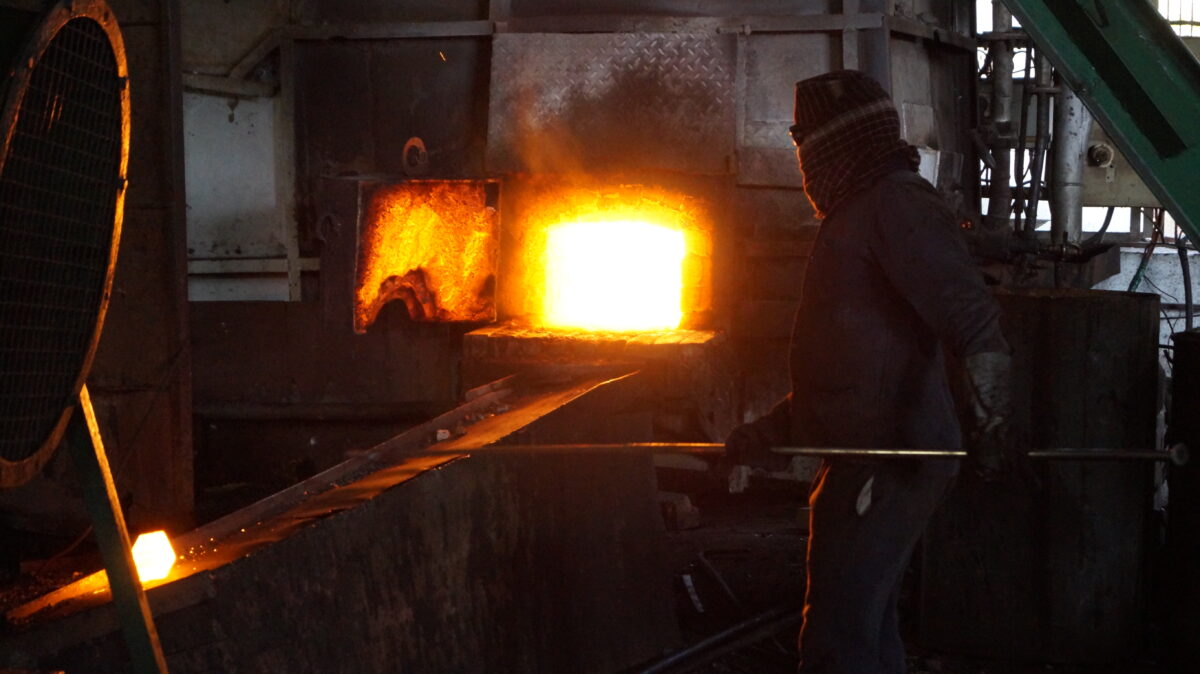
Hot forging involves heating metal to a temperature above its recrystallization point, allowing it to deform easily under compressive force. At these elevated temperatures, the metal becomes highly ductile and flows more smoothly into the desired shape.
The process results in continuous recrystallization, which refines the grain structure and eliminates internal stresses. This produces components with uniform internal properties and excellent toughness.
Hot forging is widely used in industries that require heavy duty parts such as crankshafts, connecting rods, turbine components and railway parts. However, exposure to high temperatures can lead to surface oxidation and lower dimensional accuracy, often requiring additional machining.
However, the process also has certain limitations. Exposure to high temperatures can lead to surface oxidation, which affects the finish of the component. Dimensional accuracy is lower compared to cold forging, which often requires additional machining. The need for heating also increases energy consumption.
Cold Forging Process and Industrial Relevance
Cold forging is performed at or near room temperature, where the metal is shaped using high pressure without prior heating. Since the material is not softened by heat, it offers greater resistance to deformation, requiring stronger tooling and higher forces.
During cold forging, the material undergoes strain hardening, which increases its strength as it is deformed. This results in components with excellent mechanical strength and superior dimensional accuracy. The process also produces a smooth surface finish, reducing the need for additional machining or finishing operations.
Cold forging is ideal for high volume production of smaller, precision components such as bolts, nuts, screws and various automotive and electrical parts. Its ability to produce near net shape components with minimal waste makes it highly efficient for mass manufacturing.
Despite its advantages, cold forging is limited in terms of complexity and material flexibility. It is not suitable for very large or highly intricate shapes and can lead to cracking in less ductile materials. Tool wear is also higher due to the increased forces involved.
Metallurgical Differences Between Hot and Cold Forging
From a metallurgical perspective, the differences between hot forging and cold forging are significant. In hot forging, dynamic recrystallization occurs throughout the process, leading to refined grain structure and improved ductility. This enhances the toughness of the component and makes it more resistant to impact and fatigue.
In contrast, cold forging leads to strain hardening, where the dislocation density within the material increases. This results in higher strength but reduced ductility. While cold forged components are stronger, they may be less flexible compared to those produced through hot forging.
The key takeaway is that hot forging enhances toughness and flexibility, while cold forging enhances strength and precision.
Comparative Analysis of Hot Forging and Cold Forging
Hot forging offers easier material flow, making it suitable for complex geometries and larger components. It provides high ductility and better internal grain alignment but comes with moderate accuracy and rougher surface finish. Cold forging, on the other hand, provides superior surface finish, high dimensional accuracy and excellent strength due to work hardening, but is limited in complexity and requires higher forming forces.
Tool life is generally longer in hot forging due to reduced stress on tooling, whereas cold forging leads to faster tool wear. In terms of production volume, cold forging is more suitable for large scale manufacturing, while hot forging is commonly used for medium scale production of heavy components.
Cost Considerations in Forging Processes
The cost structure of hot and cold forging differs significantly. Hot forging involves higher energy costs due to heating but benefits from lower tooling stress. However, it often requires additional machining, increasing post processing costs.
Cold forging involves higher tooling costs and requires robust equipment to handle high pressure. However, it reduces the need for finishing operations and minimizes material waste, making it more cost effective for high volume production.
Choosing the right process depends on balancing initial investment, production scale and finishing requirements.
Selecting the Right Forging Process
The choice between hot forging and cold forging depends on several factors including component size, geometry, material properties and production volume. Hot forging is preferred when large parts or complex shapes are required and when ductility is critical. Cold forging is ideal when precision, surface finish and high production volume are the primary requirements.
In many modern manufacturing environments, both processes are used in combination to achieve optimal results. This integrated approach allows manufacturers to balance performance, cost and efficiency.
Industrial Perspective
In today’s manufacturing landscape, heavy industries rely heavily on hot forging to produce structurally critical components that must withstand extreme conditions. At the same time, industries such as automotive and fastener manufacturing depend on cold forging for producing high precision components at scale.
Advanced manufacturing facilities often integrate forging with precision machining to achieve both structural strength and dimensional accuracy. This combination ensures that components meet strict engineering standards while remaining cost efficient.
Conclusion
Hot forging and cold forging are not competing processes but complementary techniques used based on specific application requirements. Each process offers distinct advantages in terms of strength, precision, cost and scalability.
A clear understanding of these differences enables manufacturers to make informed decisions that improve product performance and optimize production efficiency. Selecting the right forging method ensures that the final component meets both technical specifications and economic goals, making forging a cornerstone of modern industrial manufacturing.