
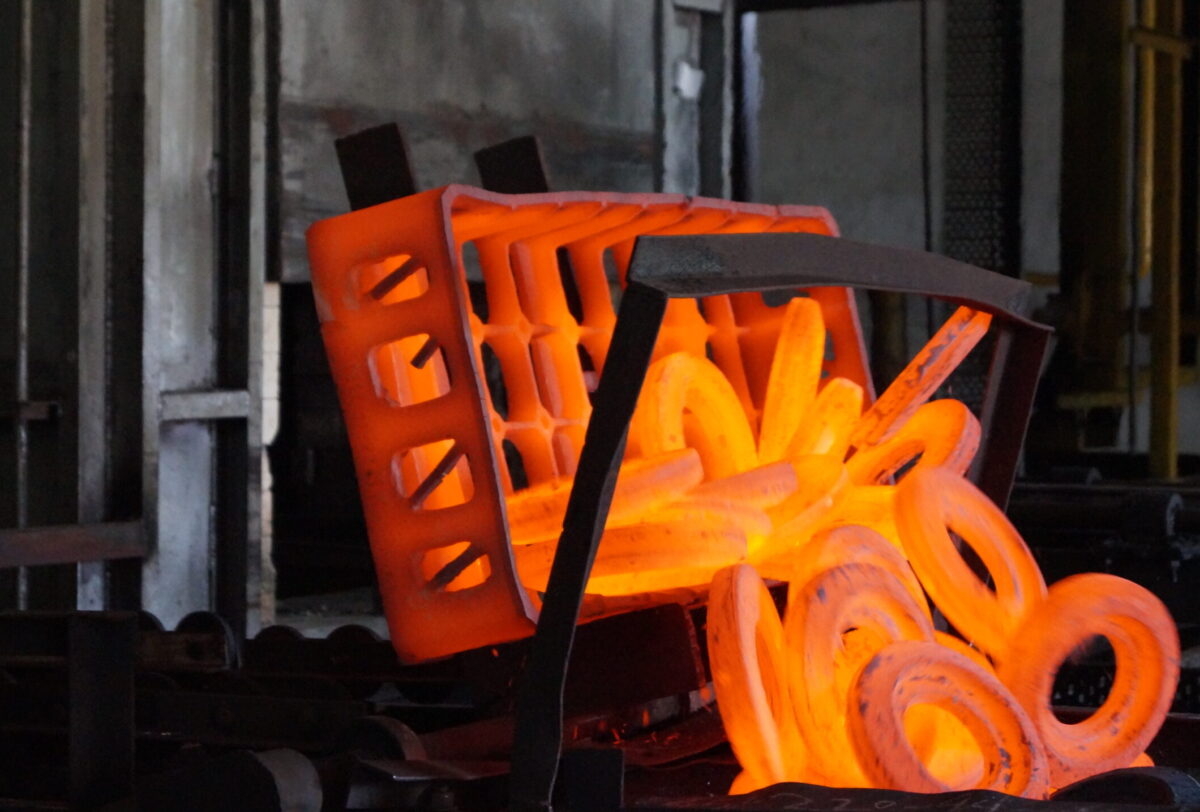
Metal shaping processes form the backbone of modern manufacturing. They transform raw metal into durable, high-performance components that power industries such as material handling, electric motors, construction equipment, mining, and heavy industrial machinery. These processes rely on controlled applications of heat, pressure, molds, and cutting tools to
create parts with the required strength, geometry, and dimensional accuracy.
Understanding the major metal shaping techniques is essential for manufacturing professionals, engineers, and procurement teams who work with industrial components. Each method offers unique advantages depending on the application, material properties, production scale, and performance requirements. Among the many techniques used in the industry, forging, machining, casting, rolling, extrusion, and drawing are six of the most widely adopted processes.
Forging
Forging is one of the oldest and most reliable metal shaping processes used in manufacturing. It involves shaping metal by applying compressive forces through presses or hammers, typically at elevated temperatures. The heat softens the metal, allowing it to be deformed into the desired shape without breaking.
What sets forging apart is its ability to improve the internal grain structure of the metal. During the forging process, the grain flow aligns with the shape of the component, resulting in significantly improved mechanical strength and fatigue resistance. This makes forged parts exceptionally durable and capable of withstanding heavy loads and demanding operating conditions. Because of these characteristics, forging is widely used to produce components such as shafts, gears, flanges, and heavy machinery parts. These components often operate in high-stress environments where structural integrity and reliability are critical. Forged parts are therefore common in industries such as construction machinery, mining equipment, and industrial gear systems.
Machining
Machining is a precision manufacturing process that removes material from a metal workpiece to achieve exact dimensions and surface finishes. Unlike forming processes that reshape the metal, machining relies on cutting tools that gradually remove excess material until the final geometry is achieved.
Modern machining operations are typically performed using CNC (Computer Numerical Control) machines that provide extremely high accuracy and repeatability. This allows manufacturers to achieve tight tolerances and complex geometries that would be difficult to produce using other metal shaping methods.
Common machining operations include turning, milling, drilling, and grinding. Each method is designed for a specific type of geometry or finishing requirement. Turning is commonly used for cylindrical components such as shafts, milling is used to create flat or contoured surfaces, drilling forms precise holes, and grinding is used for finishing operations that require high surface quality.
Machining is essential for producing high-precision components used in gear assemblies, electric motor parts, industrial shafts, and mechanical transmission systems. In many cases, machining is used as a secondary process after forging or casting to achieve the final dimensions and tolerances.
Casting
Casting is a metal shaping process in which molten metal is poured into a mold and allowed to solidify into the desired shape. Once cooled, the solidified component is removed from the mold and may undergo additional finishing operations.
This process is particularly useful for producing components with complex geometries that would be difficult or expensive to manufacture using other methods. Casting allows manufacturers to create intricate shapes, internal cavities, and large structural parts with relatively high efficiency.
Because molds can be reused for multiple cycles, casting is also suitable for high-volume production. It is commonly used in industries that require large or complex metal structures, such as engine housings, pump bodies, machine frames, and heavy equipment components.
While casting offers design flexibility and production efficiency, the mechanical strength of cast components is generally lower than that of forged parts due to differences in grain structure. For this reason, casting is often selected when complexity and cost efficiency are more critical than maximum strength.
Rolling
Rolling is a metal forming process that shapes metal by passing it through rotating rollers. The rollers compress the metal and reduce its thickness while simultaneously controlling its shape. Depending on the temperature at which the process occurs, rolling can be classified as either hot rolling or cold rolling.
Hot rolling takes place at high temperatures, making the metal easier to deform. It is commonly used to produce large structural sections, plates, and steel sheets. Cold rolling, on the other hand, occurs at or near room temperature and provides improved surface finish, tighter dimensional tolerances, and increased strength through strain hardening.
Rolling is widely used in the production of steel sheets, plates, and structural components that serve as the foundation for many industrial products. These rolled materials often become the raw input for further manufacturing processes such as machining, stamping, or fabrication.
The ability to produce metal with uniform thickness and consistent properties makes rolling a critical step in large-scale metal production.
Extrusion
Extrusion is a manufacturing process that shapes metal by forcing it through a specially designed die. As the metal passes through the die opening, it takes on the cross-sectional shape of the die, producing long components with a consistent profile.
This process is particularly valuable when manufacturers need to produce continuous metal profiles with complex cross-sections. Unlike many other forming methods, extrusion allows for intricate shapes to be created in a single step.
Extrusion is commonly used to manufacture components such as pipes, tubes, structural frames, and specialized profiles used in industrial equipment and construction applications. The process is especially popular for metals such as aluminum, which can be extruded efficiently while maintaining excellent surface finish and dimensional consistency.
Because extrusion produces continuous profiles, it is ideal for applications where long lengths of uniform cross-section are required.
Drawing
Drawing is another metal forming process that reduces the diameter of a metal workpiece by pulling it through a die. As the metal passes through the die opening, it becomes thinner and longer while maintaining a precise cross-section.
This process is widely used to manufacture wires, rods, and tubes with high dimensional accuracy. Drawing also improves the surface finish of the material, making it suitable for applications where smooth surfaces and consistent dimensions are essential.
Wire drawing is commonly used in the production of electrical wires, cables, and reinforcement materials. Tube drawing is used for precision tubing required in mechanical systems, hydraulic equipment, and industrial machinery.
The controlled deformation involved in drawing ensures consistent quality and excellent dimensional stability across long lengths of material.
The Role of Forging and Machining in Modern Manufacturing
While each metal shaping process has its own advantages, modern manufacturing often combines multiple processes to achieve optimal performance. One of the most common combinations is forging followed by precision machining.
Forging provides the structural strength and durability required for heavy-duty components, while machining delivers the dimensional accuracy needed for precise mechanical assemblies. Together, these processes enable manufacturers to produce high-strength engineered components capable of performing reliably in demanding industrial environments.
This combination is widely used in the production of gears, shafts, and mechanical transmission components used in material handling systems, electric motors, construction machinery, and other heavy industrial applications. By integrating forging and precision machining, manufacturers can achieve both structural integrity and precise engineering performance.
Conclusion
Metal shaping processes play a vital role in transforming raw metal into the engineered components that drive modern industry. Forging, machining, casting, rolling, extrusion, and drawing each offer unique capabilities that allow manufacturers to meet specific design, performance, and production requirements.
For manufacturing professionals, understanding these processes is essential when selecting the right method for a particular application. The choice of process affects not only the final performance of the component but also its cost, durability, and manufacturing efficiency.
As industries continue to demand stronger, more precise, and more reliable components, the integration of advanced forging and precision machining technologies remains a key strategy for producing high-performance metal parts used across critical industrial sectors.